Why Gig Economy Platform Taxes Feel Overwhelming [2026]
Part 3

If managing gig economy platform taxes keeps you up at night, you’re not alone. But the overwhelm isn’t just about complexity—it’s about trying to navigate a system that wasn’t designed for how you earn. This isn’t about making mistakes or lacking discipline. It’s about facing structural problems that no amount of organization can solve on your own.
The anxiety you feel? It’s valid. The confusion? It’s justified. And the sense that you’re stuck between solutions that don’t quite fit? That’s real too.
The Emotional Weight of Gig Economy Platform Taxes
The Constant Background Anxiety
Traditional employees file taxes once a year. You think about gig economy platform taxes constantly:
- Every payment from Upwork, YouTube, or Etsy triggers a mental checklist: Did I record this? Should I set aside 30%? Is this the right category?
- Every month-end brings the question: Should I be making a quarterly payment?
- Every platform email makes your heart race: Is this about taxes? Did I miss a reporting requirement?
This isn’t tax season stress. This is year-round background noise that never fully goes away. You can’t turn it off because the responsibility never stops. Traditional workers don’t experience this—their taxes happen automatically, invisibly, every paycheck.
The Imposter Syndrome Spiral
When you started earning on platforms, nobody handed you a business manual. You weren’t trained as an accountant. Yet suddenly you’re expected to:
- Classify yourself correctly (Sole proprietor? Business? Self-employed?)
- Track income from 5-7 different sources
- Understand tax treaties and currency conversion rules
- Know which expenses qualify as deductions
- Calculate estimated quarterly payments
The internal dialogue: Am I even a “real” business? Should I be doing this professionally? Everyone else seems to have this figured out—why don’t I?
The truth? Everyone else is just as confused. They’re just not talking about it publicly.
The Fear That Never Quite Disappears
Even when you think you’ve done everything correctly, there’s a persistent fear:
What if I’m wrong?
- What if the platform reported something I didn’t?
- What if I categorized income incorrectly?
- What if tax authorities see my YouTube sponsorships differently than I do?
- What if my home office deduction triggers an audit?
This fear is compounded by stories you’ve heard: someone who got audited three years later, owing back taxes plus penalties. Someone who forgot about $800 in old Fiverr income and now faces a massive bill.
Gig economy platform taxes don’t come with guarantees. There’s no HR department to confirm you did it right. There’s no automatic approval. You file, hope for the best, and live with low-level anxiety that maybe, possibly, you missed something.
The Comparison Trap
Your friend works a traditional job. They complain about taxes for one weekend in April, file their return, get a refund, and forget about it until next year.
You’re managing tax obligations every single month. You’re setting aside percentages. You’re downloading statements. You’re making quarterly payments. You’re tracking expenses. And at the end of the year, you often OWE money instead of getting a refund.
The unfairness stings. You’re working just as hard—probably harder—but the system treats you like you’re operating a complex multinational corporation when you’re just trying to earn a living on YouTube, Fiverr, and Substack.
The Systemic Problems Nobody Talks About
Tax Rules Designed for a World That No Longer Exists
Tax systems were built in an era of:
- Single employers with HR departments
- Geographic stability (you worked where you lived)
- One currency, one jurisdiction
- Consistent income and automatic withholding
Gig economy platform taxes operate in a completely different reality:
- Multiple income sources with zero coordination
- Global platforms paying in foreign currencies
- Rules that differ by country, state, even city
- Irregular income with no withholding whatsoever
The fundamental mismatch isn’t your problem to solve. But you’re expected to bridge the gap anyway—translating modern platform income into tax forms designed for 1960s employment models.
Platform Policy Changes With Zero Tax Guidance
Platforms change their fee structures, payment schedules, and reporting thresholds constantly. YouTube updates monetization rules. Etsy adjusts how VAT is collected. Upwork modifies their fee tiers.
What platforms DON’T provide: Clear guidance on how these changes affect your tax obligations.
You’re left to figure out:
- If new fee structures change your reportable income
- Whether bundled payments need to be broken down differently
- If threshold changes mean you’ll suddenly receive tax forms (or stop receiving them)
- How to report income when platforms combine or split revenue streams
Example: YouTube bundles ad revenue, memberships, Super Chats, and Shorts bonuses into one monthly payment. They don’t break it down for tax purposes—you’re expected to access analytics and separate it yourself. Why? Because their payment system isn’t designed around your tax compliance needs.
The Information Overload Problem
You try to research gig economy platform taxes. You find:
- YouTube videos giving conflicting advice
- Reddit threads where half the comments are wrong
- Blog posts from 2019 (rules have changed since then)
- Generic advice that doesn’t address multi-platform complexity
- Country-specific guidance that doesn’t apply to you
- Tax authority websites written in impenetrable legal language
The result: Analysis paralysis. You spend hours researching and end up more confused than when you started. Is home office 100% deductible or only a percentage? Can you deduct platform fees or are they already subtracted? Do you need quarterly payments if income is irregular?
Every source says something different. You can’t verify which advice applies to your specific situation (your country, your income level, your platform mix). So you either:
- Do nothing (and worry you’re making a mistake)
- Do something (and worry you did it wrong)
Neither option brings peace of mind.
The Professional Services Gap
You’re earning $25,000-$60,000 annually from platforms. You know you should get professional help. You contact accountants.
What you hear:
- “That’ll be $2,000-$3,500 for annual filing, plus $200-400/hour for consultations”
- “We don’t really work with platform income—can you organize everything first?”
- “YouTube income? We usually handle traditional freelancers…”
You can’t afford $3,000+ when you’re trying to grow your platform presence. But you also can’t confidently manage gig economy platform taxes alone with the knowledge you have.
You’re stuck in the middle:
- Too small for traditional accounting services to be cost-effective
- Too complex for DIY spreadsheet tracking to work reliably
- Too uncertain to trust generic software designed for W-2 employees or traditional freelancers
This gap—between needing help and being able to afford/find appropriate help—is where most platform earners live. Quietly stressed, constantly uncertain, hoping they’re doing it right.
Why You Feel Stuck Between Solutions That Don’t Fit
Generic Accounting Software Wasn’t Built for You
QuickBooks, FreshBooks, Wave—these tools work great if you’re:
- Invoicing clients directly
- Working in one currency
- Operating as a traditional freelancer or small business
They break down when you’re:
- Receiving payments from 7 different platforms with different fee structures
- Converting multiple currencies using official government rates
- Trying to categorize bundled income types that platforms don’t separate for you
- Managing subscriptions (Patreon), one-time sales (Gumroad), ad revenue (YouTube), and project fees (Upwork) simultaneously
You spend hours forcing platform income into categories that don’t quite fit. You manually enter currency conversions. You create workarounds for fee structures the software doesn’t understand.
The software works—technically. But it doesn’t work for you. Every month feels like wrestling with a tool designed for someone else’s workflow.
Spreadsheets Work Until They Don’t
Many platform earners start with spreadsheets. For the first year, maybe two, it’s manageable:
- One tab per platform
- Manual currency conversion lookups
- Running totals updated monthly
- Quarterly tax estimates calculated by hand
Then you cross invisible thresholds:
- Third platform added (now juggling three tabs plus a summary tab)
- Income reaches $40,000+ (transactions multiply, errors get expensive)
- You miss a month of updates (now you’re backtracking through 200 transactions)
- Currency fluctuations mean manual lookups take 30 minutes per month
Spreadsheets don’t scale. They work until they don’t. And the breaking point often arrives mid-year when you’re busiest—exactly when you can’t afford to spend 10 hours rebuilding your tracking system.
The Time Trap Nobody Mentions
Here’s what nobody tells you about managing gig economy platform taxes manually:
Time cost per month:
- Downloading statements from 5-7 platforms: 45 minutes
- Entering transactions into spreadsheet/software: 90 minutes
- Currency conversion lookups and calculations: 30 minutes
- Categorizing expenses and linking to income: 60 minutes
- Calculating estimated quarterly payment: 30 minutes
- Organizing receipts and documentation: 45 minutes
Total: 6-8 hours monthly
At $30-50/hour opportunity cost, that’s $180-$400 monthly—$2,160-$4,800 annually—in time you could spend earning more or building your platform presence.
And this assumes you’re efficient. First-year platform earners often spend 10-12 hours monthly just trying to figure out the right way to track everything.
The cruel irony: You’re spending more time managing taxes than some people spend actually earning the income.
The Hidden Cost: Decision Fatigue and Mental Load
Every day brings micro-decisions that compound into exhaustion:
- Should I track this $23 expense from Amazon? Is it business or personal?
- This coffee meeting—was it networking or just personal? Can I deduct it?
- I used my personal credit card for business software—do I need to transfer money between accounts to “reimburse” myself?
- The platform fee was $47 this month—do I need to record that separately or is it already reflected in my net payment?
These aren’t big decisions. But you make 10-20 of them daily. By month-end, you’ve made 300 tiny judgment calls, each carrying the weight of “What if I’m wrong and this triggers an audit?”
Traditional employees make zero of these decisions. Their taxes are handled automatically. They buy coffee, swipe a card, done. No mental overhead. No second-guessing.
Gig economy platform taxes turn every transaction into a potential tax decision. The mental load never stops. And unlike the time cost (which you can measure), the mental load is invisible—you just feel perpetually tired and slightly anxious without knowing why.
The Validation You Need to Hear
If managing gig economy platform taxes feels impossible, it’s not because you’re disorganized, lazy, or bad at business. It’s because:
The system wasn’t designed for you.
Tax rules were written when:
- People had one employer for 20+ years
- “Side gig” meant mowing neighbors’ lawns for cash
- International income meant you were a corporation with dedicated accounting staff
- Currency conversion was something only import/export businesses handled
You’re operating in a world where:
- Changing platforms every few years is normal
- “Side gig” means earning $40,000 annually across YouTube, Upwork, and Etsy
- International income is default (most platforms pay in USD regardless of your location)
- Currency conversion is something every platform earner manages monthly
The mismatch is structural. No amount of personal effort bridges a systemic gap.
You’re not failing at something you should naturally understand. You’re trying to translate modern platform income into a tax framework that predates the internet. That’s not a personal shortcoming—it’s an impossible ask.
The overwhelm is the correct response to an objectively overwhelming situation.
There IS a Way Forward
You don’t have to accept that gig economy platform taxes will always feel impossible. The anxiety, the confusion, the constant mental load—these aren’t permanent conditions.
What if:
- Tax tracking didn’t require 6-8 hours of manual work each month?
- You had confidence that everything was categorized correctly?
- Currency conversions happened automatically using the right official rates?
- You knew exactly what you owed and when, without calculating by hand?
- The system actually understood how platform income works—not just traditional employment?
This isn’t theoretical. Platform earners who’ve moved past the overwhelm didn’t suddenly become accounting experts. They found systems that match how they actually earn.
In Part 4, we’ll show you what that looks like:
- The complete solution for managing gig economy platform taxes
- How to optimize deductions by platform type (creator vs service provider vs e-commerce)
- When to upgrade your business structure (and the income thresholds that actually matter)
- Why PlatformTaxHub was built specifically for this problem—and how it eliminates the tracking, conversion, and calculation burden
The overwhelm ends when you stop using tools designed for traditional employment and start using systems built for multi-platform income.
Read Part 4: The Complete Platform Income Tax Solution →
Know Where You Stand Right Now
Before building a complete system, understand your current tax obligation.
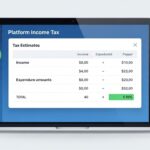
Use our free tax calculator – Built for multi-platform earners. Input income from Upwork, YouTube, Etsy, Fiverr, TikTok, Substack—however many platforms you use. Get country-specific estimates. See what you should be setting aside. Takes 60 seconds.
Understanding your actual numbers is the first step toward eliminating the anxiety around gig economy platform taxes.
About this series: This is Part 3 of 4 in our guide to managing platform income taxes. We’ve covered what platform income is, common mistakes, and now the systemic reasons it feels overwhelming. Part 4 brings the solution.
Previously:
- Part 1: What is Freelance Platform Income and Why It’s Different
- Part 2: 7 Platform Tax Mistakes That Cost Thousands
Related: The Silent Tax Truth No One Mentions When You Earn Online